

BUSANGA PLAINS
KAFUE NATIONAL PARK >

TUCKED AWAY IN THE REMOTE NORTHERN REACHES OF KAFUE NATIONAL PARK, THE BUSANGA PLAINS STANDS AS A TESTAMENT TO RAW, UNTAMED AFRICA. OFTEN DESCRIBED AS THE "CROWN JEWEL OF KAFUE," THIS VAST, SEASONAL FLOODPLAIN IN ZAMBIA IS A WILDLIFE SPECTACLE, FAMED FOR ITS REMARKABLE CONCENTRATIONS OF GAME AND ITS UNIQUE, WATER-LACED LANDSCAPE.
A SEASONAL
WETLAND
ECOSYSTEM
The Busanga Plains is a vast, fertile expanse covering approximately 720 square kilometers, sustained by the Lufupa River, a tributary of the Kafue. This seasonal wetland system, recognized as a Ramsar site, is essentially an ancient lake bed that transforms dramatically with the seasons.
During the rainy season, the plains flood, leaving behind scattered, elevated "islands." It is only for a precious five-month window, typically from June to October, that the water recedes sufficiently to allow access. This recession reveals a sprawling sea of golden grass, punctuated by graceful date palms, sycamore fig, and sausage trees, creating one of the most pristine and diverse habitats in Africa.
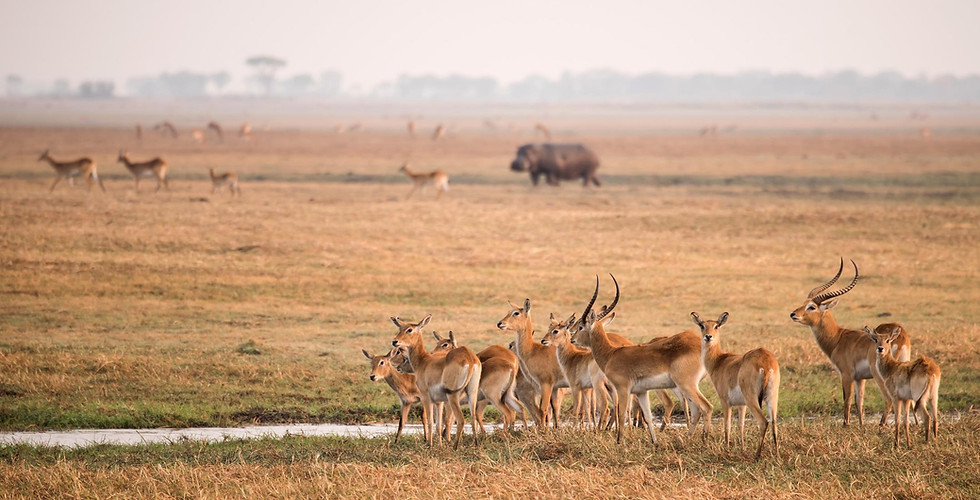

THE SHEER ABUNDANCE AND VARIETY OF GAME IN BUSANGA GIVE RISE TO ITS MONIKER, THE "PLAINS OF PLENTY." THE ECOSYSTEM THRIVES ON THE MOSAIC OF WATER CHANNELS AND GRASSLANDS, SUPPORTING OVER 20 SPECIES OF UNGULATES AND A RICH ARRAY OF PREDATORS.
-
Antelope: Busanga is best known for its thriving herds of red lechwe and puku, which can be seen splashing and leaping across the shallow water channels. Conservation efforts have seen the lechwe population rebound significantly over the past decades. The plains are also a critical haven for rare and majestic antelope like the roan, sable, and the secretive, swamp-dwelling sitatunga. Other species frequently spotted include blue wildebeest, Lichtenstein’s hartebeest, oribi, and buffalo.
-
Lions of the Water: The lions here are arguably the stars of the drama. They have developed an unusual behavioral trait: hunting their aquatic prey (like lechwe) even when it involves plunging through deep water, a sight rarely seen elsewhere in Africa. Large prides, often featuring impressive black-maned males, thrive on the abundant prey base.
-
Other Predators: The open areas of the plains make it one of the few places in Zambia where cheetahs can be regularly sighted. Leopards tend to favor the tree-line on the edge of the plains, while spotted hyena and wild dogs also complete the predator profile.

Kafue National Park is designated an Important Bird Area, and Busanga Plains alone hosts over 450 bird species. This wetland is a crucial sanctuary for spectacular waterbirds and rare species. It is one of the few known breeding sites for the endangered wattled crane and the grey crowned crane. Additionally, the plains are the exclusive home of Zambia’s only endemic bird, the Chaplin’s barbet. Other avian highlights include the African fish eagle, Ross' turaco, and various flamboyant storks.
A
BIRDWATCHER'S
PARADISE

CONSERVATION
The Zambian Carnivore Programme (ZCP) is a long-running conservation initiative focused on researching, monitoring, and protecting Zambia’s large carnivores—particularly lions, wild dogs, cheetahs, leopards, and hyenas—and the ecosystems they depend on. Their work combines scientific research, anti-snaring and veterinary interventions, community-based coexistence programmes, and the training of Zambian conservation leaders. ZCP operates primarily in South Luangwa, the Greater Kafue ecosystem, and Liuwa Plain, with additional work in surrounding Game Management Areas and emerging conservation landscapes. In the Kafue, their efforts are closely aligned with African Parks, which now manages the national park in partnership with the Zambian government, providing strengthened law enforcement, ecological restoration, and community engagement frameworks that support ZCP’s long-term carnivore monitoring and recovery work.
DUE TO ITS SEASONALITY AND REMOTENESS, BUSANGA PLAINS OFFERS AN INTIMATE, OFF-THE-BEATEN-TRACK SAFARI EXPERIENCE.
Luxury camps like Shumba and Chisa Busanga are typically situated on wooded islands within the plains, providing endless views and wildlife viewing right on the doorstep. There are a range of good mid-range camps too.
The presence of tourism operators has also played a direct role in conservation, helping to reduce poaching and bolster the overall management and protection of this extraordinary ecosystem, particularly since the 2022 management partnership agreement between Zambia’s Department of National Parks and Wildlife and African Parks.

STAY HERE


